What Is a Cast Iron Sewer Pipe? Texas Lifespan Guide
September 29, 2026
Texas homeowner guide
What Is a Cast Iron Sewer Pipe?
A cast iron sewer pipe is a heavy, iron-based drain pipe formed in a foundry to carry wastewater by gravity. This guide explains what it is made of, how the pipe is manufactured, and how long an underground cast iron sewer may last in Texas.
The short answer
Cast iron is a strong drain-pipe material, but its condition matters more than its birthday.
A cast iron sewer pipe is manufactured from molten iron formulated for drain, waste, vent, and sewer service. In a modern foundry, pipe is normally made by centrifugal casting: a measured amount of molten iron is poured into a rotating horizontal mold, and centrifugal force spreads the metal into a uniform cylinder. Fittings are commonly made separately in stationary sand or metal molds.
For homeowner planning in Texas, it is reasonable to treat approximately 50 years or more as a baseline service-life expectation under suitable conditions and to view 50 to 75 years as a practical inspection window for many older residential systems. That range is not a warranty or a replacement deadline. Some lines deteriorate sooner, while others remain serviceable much longer. Soil chemistry, moisture, wastewater, installation, joints, slope, movement, and maintenance all affect the result.
What is a cast iron sewer pipe?
In residential plumbing, the term usually refers to cast iron soil pipe used in the drain, waste, and vent system. “Soil pipe” is the traditional plumbing term for piping that can carry discharge from toilets and other fixtures. It may run vertically inside a wall, horizontally beneath a floor, under a concrete slab, through a crawlspace, or underground between the house and the public sewer connection or private disposal system.
This pipe is designed primarily for gravity flow rather than high-pressure water service. Wastewater should move through it because the pipe has the correct slope. The pipe is heavy, rigid, noncombustible, and good at reducing plumbing noise. Those qualities helped make it common in older Texas homes and commercial buildings.
Two connection styles are common. Hub-and-spigot pipe has an enlarged bell or hub at one end that receives the next pipe. Older joints may contain oakum and lead; later systems may use compression gaskets. Hubless, or no-hub, pipe has straight ends joined by listed couplings. The pipe body, fittings, and joints must be evaluated together because a line can leak or shift at a connection even when the nearby barrel of the pipe remains intact.
What is cast iron sewer pipe made of?
Cast iron is not pure elemental iron. It is an iron-based alloy whose chemistry and cooling behavior produce the properties needed for casting. The Cast Iron Soil Pipe Institute handbook describes the basic foundry charge as scrap iron, steel scrap, alloys, coke, and limestone. Carbon and silicon can be added in controlled amounts to reach the required final composition.
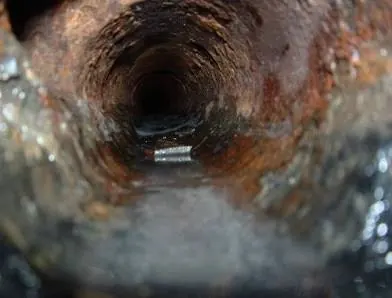
In ordinary gray cast iron, much of the carbon appears as microscopic graphite flakes in the metal structure. Those flakes help molten iron flow into a mold and make the solid material machinable, but they also explain an important aging mechanism. When corrosion gradually removes iron from a localized area, a graphite-rich skeleton may remain. The surface can keep its general shape even though the metal has lost strength. This deterioration is often called graphitic corrosion or graphitization.
Modern standards control more than a casual ingredient list. Foundries test chemistry and physical properties during production. The CISPI technical handbook identifies a minimum carbon equivalent of 4.10 by mass under the referenced CISPI and ASTM requirements, using a calculation based on carbon, silicon, and phosphorus. Finished products are manufactured to dimensional and performance specifications for their pipe type.
Why recycled metal can still become a controlled product
Using scrap does not mean the finished pipe has random properties. The furnace charge is selected, melted, adjusted, and tested. Current CISPI member information states that U.S.-made cast iron soil pipe and fittings contain more than 96 percent post-consumer scrap and remain recyclable at the end of use. Production control is what turns those feed materials into pipe that meets the applicable standard.
Cast iron soil pipe should not be confused with steel pipe or modern ductile iron pressure pipe. They are all iron-based materials, but their metallurgy, intended applications, joining systems, and governing standards differ. In a house, identifying the actual material matters before a plumber chooses cutting tools, couplings, support, or a replacement method.
How is cast iron sewer pipe formed and manufactured?
Manufacturing takes place in a foundry, where raw material preparation, melting, casting, cooling, finishing, and quality control are organized as a continuous process. The exact equipment varies by manufacturer, but the essential sequence is consistent.
The foundry prepares the charge
Scrap iron, steel scrap, selected alloys, coke, and limestone are measured for the melt. Carbon and silicon can be adjusted so the molten iron reaches the required chemistry.
The metal is melted and controlled
A cupola furnace or electric melting equipment brings the charge to a fully molten state. The CISPI handbook notes that molten iron at a cupola taphole is normally in the range of about 2,700°F to 2,900°F. Samples and metallurgical tests help control composition and physical properties.
A rotating mold forms the pipe
For straight pipe, a premeasured amount of molten iron enters a horizontal mold while the mold spins. Centrifugal force spreads the liquid metal against the mold wall. As the iron solidifies, it forms a concentric hollow cylinder with controlled wall thickness.
Stationary molds form the fittings
Bends, tees, wyes, and other fittings are typically cast in stationary sand molds or reusable metal molds. A core creates the interior flow passage while the surrounding mold shapes the exterior.
The casting cools and is finished
After solidification, the pipe or fitting is removed, cleaned, inspected, finished, marked, and tested as required. Dimensional checks and production quality controls help confirm that the finished product meets the relevant specification.
The result is a rigid pipe with substantial wall mass. That mass contributes to strength and sound control, but it also makes installation labor-intensive. Cast iron must be supported, cut, joined, and aligned correctly. Underground performance still depends on the trench, bedding or support conditions, joint assembly, grade, and surrounding soil.
Know What Is Underground Before You Approve the Repair
CISRS can review the visible pipe condition, locate accessible sections, and prepare a written repair or replacement scope for your property.
How long does cast iron sewer pipe last in the ground in Texas?
There is no single Texas expiration date for buried cast iron. A reasonable homeowner answer is that a properly installed line in a compatible environment may provide roughly 50 years or more of service, and many discussions use 50 to 75 years as a practical range for older residential pipe. However, the actual condition of one line can fall on either side of that range.
TxDOT’s durability guidance for permanent drainage facilities uses 50 years as a general ideal service-life expectation while emphasizing that corrosion, abrasion, material selection, design, maintenance, and the local environment change the outcome. That highway guidance is not a warranty for a house sewer, but its durability principles are relevant: pH, soil and water resistivity, salts, moisture, and exposure can materially change corrosion risk.
TxDOT notes that strongly acidic soil or water and strongly alkaline conditions can threaten conduit life. It also explains that low resistivity generally corresponds to higher corrosion potential. Texas contains many different soil environments, so statewide age alone cannot tell a homeowner what is happening under a particular slab or yard.
Conditions that can shorten service life
- Soil chemistry: acidity, alkalinity, salts, and low resistivity can increase exterior corrosion potential.
- Persistent moisture: wet soil and groundwater can support corrosion and expose weak joints.
- Wastewater conditions: repeated exposure to aggressive waste, gases, or long periods of standing water can attack the interior.
- Poor grade or bellies: a low section that holds wastewater and solids may deteriorate differently from a properly draining run.
- Movement: settlement, expansive soils, foundation movement, or inadequate support can stress rigid pipe and connections.
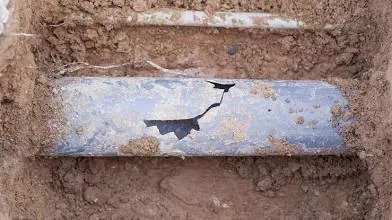
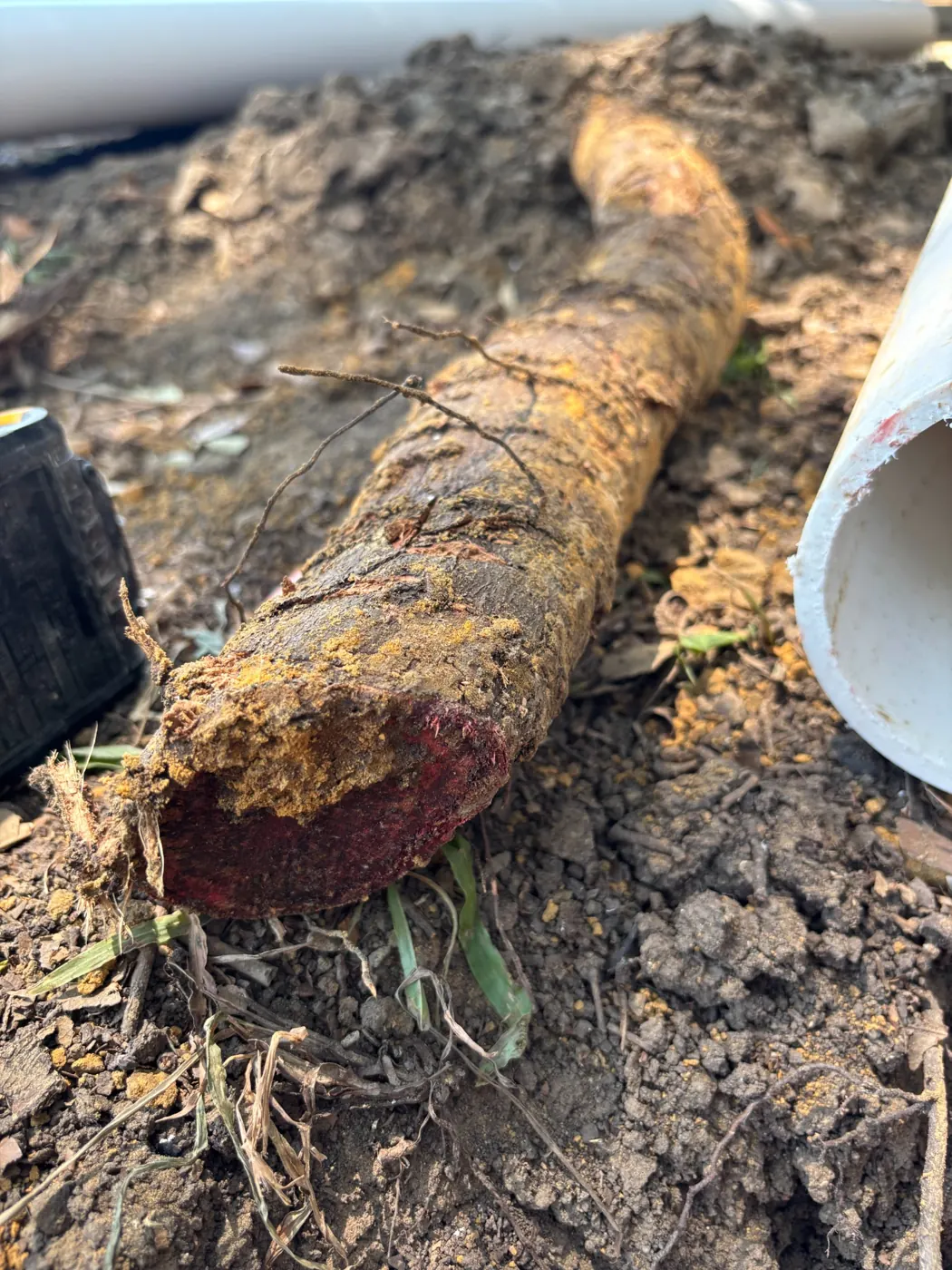
- Joint condition: a failed joint may leak, admit soil, allow root entry, or create an offset even when adjoining pipe remains usable.
- Installation details: alignment, support, backfill, loading, and connection workmanship influence long-term performance.
- Cleaning history: aggressive mechanical cleaning can damage pipe that has already lost wall thickness.
Conditions that may support longer service
A line may remain functional longer when it has stable support, proper slope, sound joints, limited corrosive exposure, and no chronic wastewater backup. The heavy pipe wall can tolerate years of normal service. That is why CISRS does not recommend replacement solely because a home was built in a particular decade.
What happens when buried cast iron begins to fail?
Deterioration does not always appear as one dramatic break. The inside may become rough and scaled, reducing the effective opening and catching paper or solids. The bottom of a horizontal line may thin because it receives the most continuous contact with wastewater. Localized corrosion can create pits, channels, or missing sections. A rigid pipe may crack, and a joint may shift or separate.
Homeowners may notice recurring backups, multiple slow fixtures, sewer odors, damp soil, unexplained settlement near the line, or a drain that improves after cleaning and then clogs again. Those symptoms are reasons to investigate, not proof that the entire cast iron system must be replaced. Grease, roots, foreign objects, poor venting, fixture problems, and defects in other pipe materials can create similar complaints.
How do you determine whether a cast iron sewer needs repair or replacement?
The process starts with evidence. A sewer camera can document accessible interior conditions such as scale, standing water, offsets, roots, cracks, or a missing pipe wall. A locator can help estimate the camera head’s position and depth. Accessible cleanouts, fixture branches, the foundation, the yard route, and the public connection all affect what can be seen and what repair options are practical.
A camera also has limits. Heavy buildup or standing water may block the view. The lens shows the interior surface, not the full remaining wall thickness. Distance counters and electronic locating are useful planning tools but should be checked against actual site conditions. A single image without context should not be treated as a complete construction scope.
A useful written evaluation should separate four things: the observed condition, the likely location, the proposed work, and the items that remain subject to field verification. That separation helps a homeowner compare bids without assuming every contractor is pricing the same route, access method, branch connections, testing, permit work, backfill, and restoration.
Repair, replace, tunnel, or reroute?
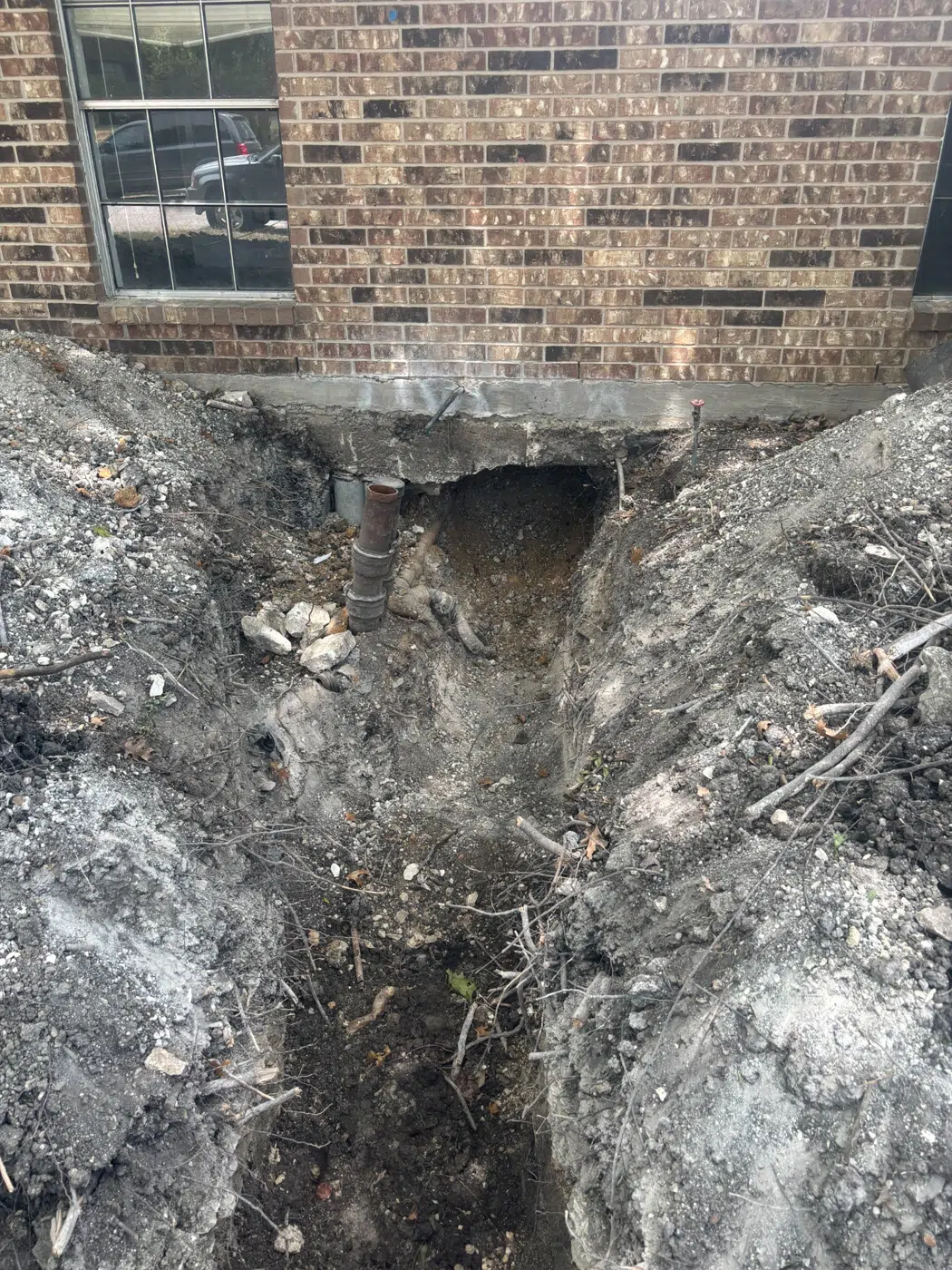
No method fits every Texas home. The correct approach depends on the damaged length, depth, grade, number of fixture branches, foundation, yard access, utilities, finished surfaces, and local requirements. A short accessible failure may support a targeted repair. Multiple failed sections may justify a broader replacement. In some layouts, an exterior reroute can reduce the amount of work beneath the slab, but the new route still needs adequate fall and compliant connections.
| Approach | When it may fit | When it may not fit | Key limitation |
|---|---|---|---|
| Targeted repair | One documented, accessible defect | Widespread corrosion or several failed sections | Nearby older pipe remains in service |
| Through-slab replacement | Direct access is practical and restoration is defined | Extensive finished surfaces or difficult occupancy conditions | Concrete and interior restoration must be planned |
| Under-slab tunneling | Selected under-slab runs can be reached safely from outside | Soil, structural, access, or safety conditions make tunneling unsuitable | Requires project-specific excavation and support planning |
| Exterior reroute | Fixtures can reach a compliant outside route with adequate grade | Branch locations, elevations, utilities, or property layout block the route | Not every fixture can be moved to an exterior path |
| Open trenching | Yard sections are accessible | Utilities, hardscape, trees, or depth create major constraints | Surface removal and restoration vary by site |
| Lining or pipe bursting | Only when the existing configuration and product requirements support it | Collapsed pipe, severe offsets, branch complexity, or unsuitable access | Inspection and method-specific engineering are essential |
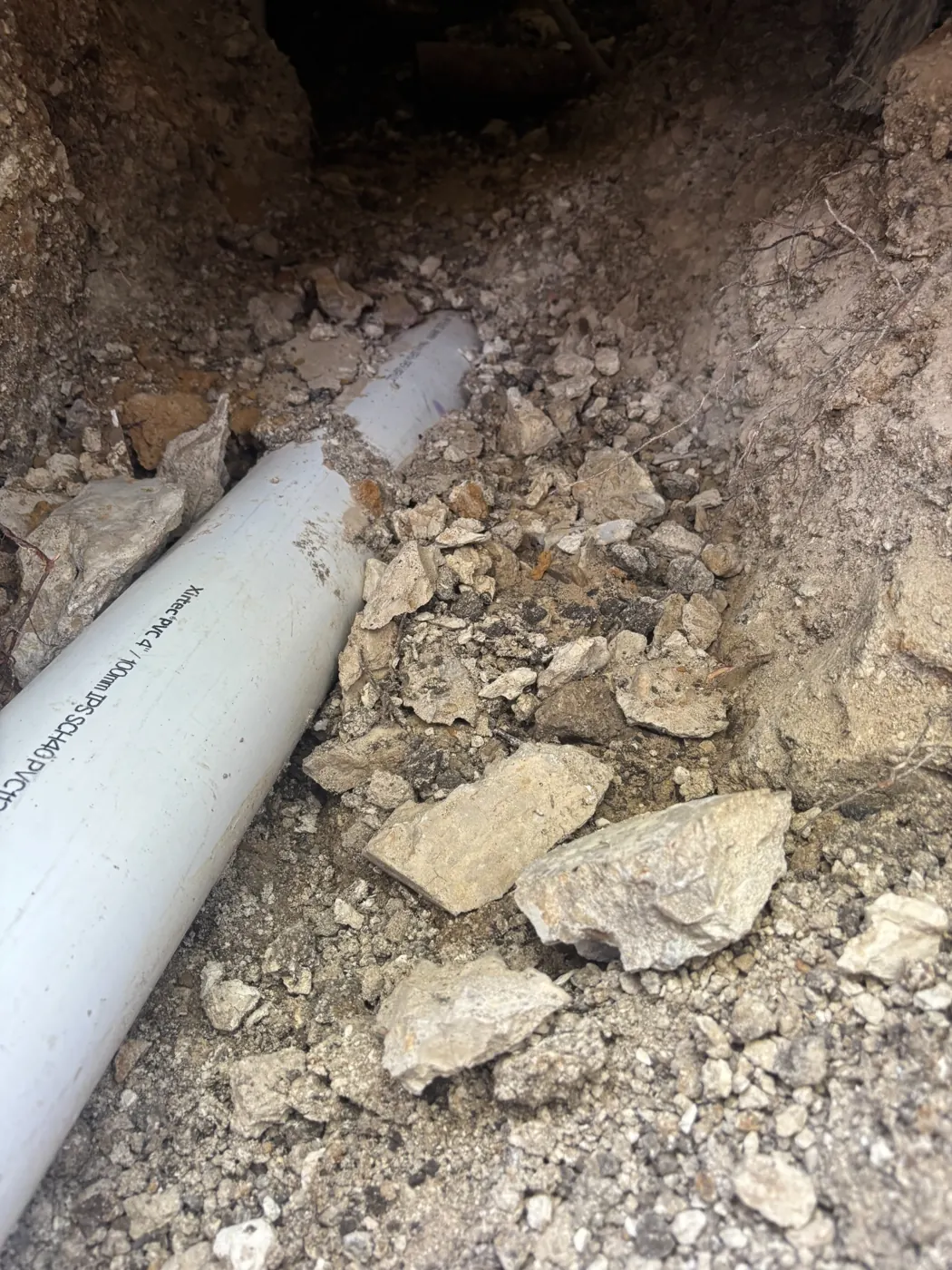
What controls the cost?
Property-specific pricing should follow an inspection and written scope. Major cost drivers include the length and depth of pipe, under-slab footage, number of branch connections, access, excavation method, concrete or hardscape, landscaping, utility conflicts, permit and inspection requirements, testing, backfill, haul-off, and restoration. A low number without a defined route may exclude work that another proposal includes.
Technical sources
This article uses industry standards and public engineering guidance for its manufacturing and durability explanations. The 50–75-year Texas discussion is a practical planning range, not a code requirement, product warranty, or prediction for a particular property.
Local cast iron sewer specialists
Serving Dallas–Fort Worth homeowners.
CISRS evaluates cast iron sewer problems, repair choices, replacement routes, and eligible reroute options across North Texas. Additional DFW cities are served by scheduling availability.
Master plumber-led scope
Evidence first. Then the repair plan.
Steven Shipler, MBA, Texas Responsible Master Plumber RMP 45825, leads CISRS’s approach to cast iron sewer planning. The process begins with available camera findings, locating, depth, layout, access, and a written scope. Site visits and field work may be completed by qualified team members under the appropriate licensed oversight.
Frequently asked questions
Questions about cast iron sewer pipe in Texas
Is every old cast iron sewer pipe bad?
No. Age is a reason to inspect, not proof of failure. A recommendation should be based on visible condition, recurring symptoms, grade, joints, access, and the extent of documented defects.
Can cast iron last longer than 75 years?
Yes. Some cast iron systems remain functional beyond that point. Other lines fail earlier. Material thickness, soil chemistry, moisture, wastewater exposure, movement, slope, joints, and installation can create very different outcomes.
Can a sewer camera tell the remaining life of the pipe?
Not precisely. A camera can document accessible interior conditions, but it does not measure every part of the wall or predict an exact failure date. It should be combined with locating, site observations, service history, and the property layout.
Does surface rust mean the whole sewer must be replaced?
No. Surface appearance alone does not define the condition of an entire system. The location, depth, wall condition, cracks, missing sections, joints, slope, and number of affected runs must be evaluated.
Can cast iron under a slab be replaced?
Yes, but the access method is property-specific. Possible approaches include selected through-slab access, tunneling from outside, or rerouting eligible branches. Structure, soil, depth, safety, fixture connections, and local requirements influence the choice.
Can the sewer be rerouted outside the house?
Sometimes. A reroute requires a workable path, adequate fall, accessible fixture or branch connections, room for excavation, and compliance with local requirements. It is not practical for every floor plan.
How long does replacement work take?
Timing depends on footage, depth, access, excavation method, branch connections, permits, inspection scheduling, testing, backfill, and restoration. A written property-specific scope should state the anticipated sequence and clarify what is included.
What should I compare between sewer estimates?
Compare the documented defect, proposed route, pipe footage, access points, branch connections, testing, permits, inspections, backfill, haul-off, surface restoration, exclusions, and warranty terms. Two prices may describe very different work.
Ready to Find Out What Is Happening Beneath Your Home?
Tell us your city, the symptoms you are seeing, and whether you already have a sewer camera video. We will help you identify the next useful step.